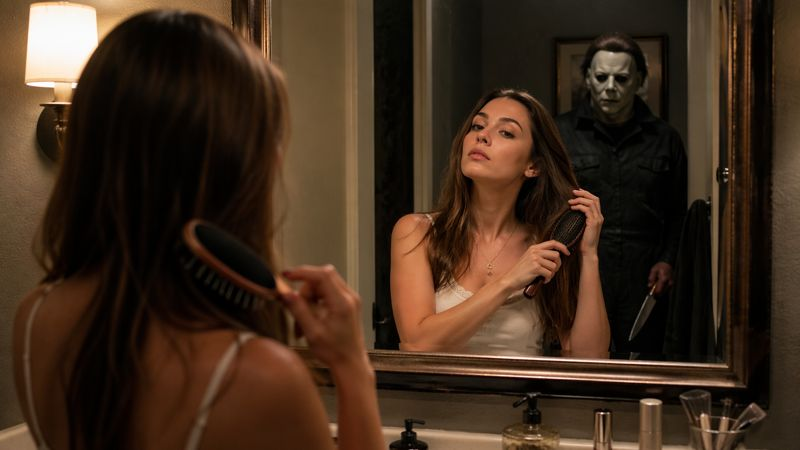
Television only works because common sense takes the day off. Entire episodes survive because nobody in them can hear footsteps, use a lock, answer a phone, or make one smart decision under pressure. If characters in television had even a basic survival instinct, half the shows we’ve watched over the years would’ve ended before the first commercial break.
Take the classic horror scene that audiences have seen a thousand times. A woman stands in front of the mirror brushing her hair while the camera slowly reveals the killer standing directly behind her. The audience sees him, the camera sees him, and somehow the only person in the room who doesn’t see him is the one about to die.
Movies like Halloween made an art form out of this. Michael Myers can stand in a dark hallway like a coat rack and remain completely unnoticed until the exact wrong moment. In Scream, Ghostface can be close enough to breathe on someone’s neck before they realize they might be in danger.
Then there’s the line that never helps anybody. “I’m calling the police” has been spoken in more bad situations than almost any other phrase in television history. Instead of quietly dialing 911, characters feel the need to announce it like a press release and give the villain enough time to react.
The same thing happens when the group decides to split up. For some reason, television has convinced generations of viewers that the smartest way to survive danger is to separate and become easier targets. Scooby-Doo, Where Are You! practically built a business model around terrible teamwork, and somehow, people are still following the strategy.
Then there’s the mysterious noise in the basement. It’s never a harmless noise, and yet someone always decides to investigate it alone. They usually do this without shoes, without a weapon, and without enough light to see their own hand in front of their face.
The worst part is the greeting. Someone always whispers “Hello?” into the darkness as if the killer is going to politely answer back and explain the misunderstanding. In A Quiet Place, where silence means survival, people still make enough questionable decisions to have viewers yelling at the screen.
Another television favorite is the one sane person nobody believes. Joyce in Stranger Things spent an entire season trying to explain that weird things were happening, and everybody treated her like she’d lost her mind. The woman was talking to her son through Christmas lights and somehow that still wasn’t enough proof for people.
Then there’s the villain speech that saves the hero every time. The hero is captured, tied up, and completely helpless, and the villain decides now is the perfect time to explain the entire plan. Instead of ending the problem, they reveal motives, childhood trauma, future plans, and somehow leave enough time for an escape.
Austin Powers made fun of this perfectly. Scott Evil asked the obvious question that audiences had been asking for years when he wondered why they didn’t just kill him. It was one of the funniest moments in the movie because it was also completely true.
Finally, there’s the decision to run upstairs instead of out the front door. The exit is right there, freedom is right there, and somehow the victim chooses the room with one window that won’t open. Television survives because logic doesn’t, and if one character ever made the right decision, the episode would be over in five minutes.